
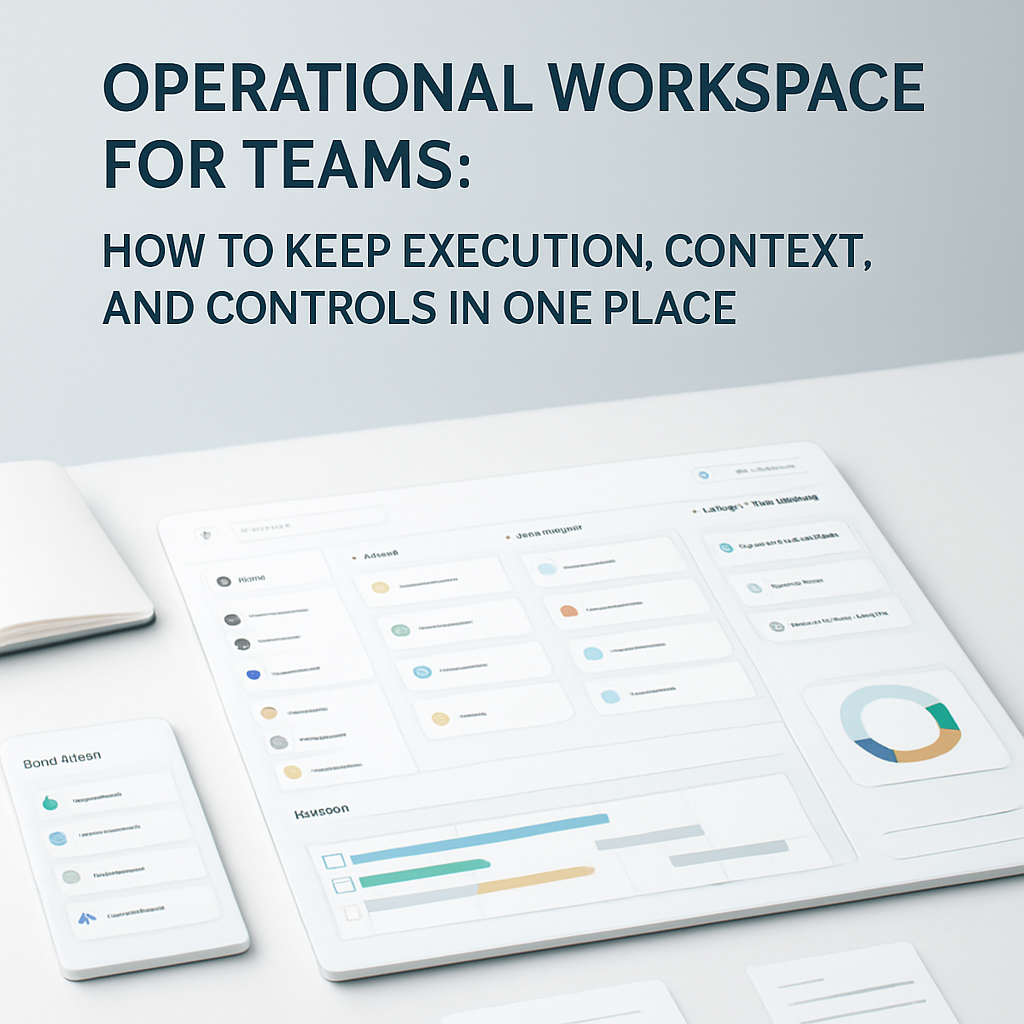
# Operational Workspace for Teams: How to Keep Execution, Context, and Controls in One Place
An **operational workspace for teams** is a shared place where work is not only discussed, but also assigned, planned, updated, reviewed, and tracked with enough context to keep execution moving.
Many teams already have task lists, chat threads, notes, calendars, spreadsheets, and status meetings. The problem is that those pieces often live in separate tools. A decision happens in chat, the task lives somewhere else, the deadline is in a spreadsheet, the latest context is in a note, and the owner is clarified in a meeting that not everyone attended.
That fragmentation creates avoidable follow-up:
- Who owns this?
- What is the current status?
- Where is the latest context?
- What changed since yesterday?
- Which team or workspace does this belong to?
- Was this decision captured anywhere?
Borative Workspace OS is designed for teams that want a more focused operating layer: tasks, planning, chat, notes, add-ons, notifications, team administration, activity history, and workspace controls in one canvas.
This guide explains what an operational workspace should include, how teams can use it in practice, and how Borative helps keep execution and context closer together.
What is an operational workspace?
An operational workspace is a digital environment where a team can coordinate day-to-day execution across tasks, communication, planning, and accountability.
Unlike a simple task list, it does not stop at “what needs to be done.” It also keeps nearby the supporting context that helps work move forward:
- Task owners
- Priorities
- Due dates
- Subtasks
- Statuses
- Comments
- Images and supporting context
- Team conversations
- Notes
- Timeline planning
- Workspace activity
- Membership and role controls
For small teams, founders, agencies, consultants, project managers, and operations teams, this can reduce the need to constantly jump between disconnected tools just to understand what is happening.
An operational workspace does not remove the need for human judgment, planning, or communication. Instead, it gives teams a clearer place to organize those activities.
Why teams outgrow scattered task and chat workflows
Early-stage teams often start with whatever is fastest: a chat app, a shared doc, a spreadsheet, and a personal task list. That can work for a while. But as more people, projects, and decisions enter the system, coordination becomes harder.
Common symptoms include:
1. Tasks lose context
A task title may say “Update client report,” but the actual requirements are hidden in a chat thread, image, meeting note, or comment from last week. When the owner starts working, they have to search across tools before they can execute.
2. Chat creates motion but not always accountability
Team chat is useful for quick alignment, but conversations can move fast. If decisions are not connected to tasks, owners, or statuses, the team may feel active without having a reliable execution record.
For a deeper look at this problem, see Team Chat and Task Management: How to Keep Conversations Connected to Execution.
3. Planning happens separately from execution
A timeline or plan is helpful only if it reflects the work actually being done. When planning lives in one place and task updates live somewhere else, the plan can become outdated quickly.
4. Ownership becomes unclear
When multiple people discuss the same work, it is easy for ownership to become implied instead of explicit. Operational work needs clear owners, statuses, and due dates so the team knows who is responsible for the next step.
5. Admin and access controls become an afterthought
As a workspace grows, teams need basic controls: who can join, who belongs to which team, who can administer the workspace, and how membership is managed. Without those controls, operational clarity can suffer.
What an operational workspace should include
A useful operational workspace should bring together several core layers of team execution.
1. Task management with owners, status, and context
Tasks are the foundation of operational work. But a task is more useful when it includes the details needed to act on it.
In Borative, teams can organize work with task details such as:
- Owners
- Subtasks
- Priorities
- Due dates
- Statuses
- Comments
- Images
- Supporting context
This helps make the task more than a reminder. It becomes a working unit that shows what needs to happen, who is responsible, what matters most, and what information is available.
For teams that handle many parallel requests, this structure can make follow-up more concrete. Instead of asking “Did anyone handle this?”, the team can look at the owner, status, comments, and timeline context.
2. Shared workspaces and team scopes
Not every piece of work belongs in the same place. A founder may need a personal workspace for individual planning, while an operations team may need a shared workspace for company execution. Agencies and consultants may also separate internal work from client-facing projects.
Borative supports personal workspaces, shared workspaces, team scopes, workspace membership, team membership, owner roles, and admin roles. This helps teams organize execution by the right operating context.
A practical structure might look like this:
- A personal workspace for individual capture and planning
- A shared workspace for company-level priorities
- Team scopes for operations, delivery, marketing, or client work
- Admin and owner roles for workspace management
- Join requests or access codes for controlled participation
This kind of structure is useful when a team wants flexibility without turning every project into a separate disconnected system.
3. Chat that stays close to execution
Communication is part of execution. Teams need to ask questions, clarify decisions, react to updates, and coordinate next steps.
Borative includes communication features such as direct messages, team chats, mentions, reactions, presence, and realtime notifications. The goal is not to replace the need for thoughtful communication, but to keep operational conversations closer to the work they affect.
When chat and execution live too far apart, the team has to manually translate conversations into actions. When they are closer together, it becomes easier to move from “we discussed it” to “this is the owner, task, status, and next step.”
4. Notes and add-ons beside the core canvas
Operational work often needs supporting utilities: quick notes, calculations, translation, calendar or timeline views, and other productivity modules.
Borative includes an add-on system that can extend the workspace with practical utilities such as Easy note, calculators, translators, calendar or timeline tools, and other productivity modules beside the core canvas. Availability can depend on plan gates or add-on access, so teams should review what is available for their workspace and plan.
The advantage of this approach is that teams can extend the workspace without scattering every small workflow into a separate tool.
To explore this idea further, read Workspace Add-ons for Teams: How to Extend Your Operational Workspace Without Scattering Work.
5. Timeline planning and operational visibility
A team needs to understand not only what exists, but also when it should happen and how work is moving.
Borative supports visual planning surfaces, timeline planning, summary metrics, and operational dashboards. These surfaces can help teams review workload, deadlines, ownership, and status movement in a more visible way.
This is especially useful for:
- Weekly planning
- Project reviews
- Client delivery coordination
- Founder operating rhythms
- Remote team alignment
- Operations check-ins
- Agency production tracking
The goal is not to create a perfect plan that never changes. The goal is to create a visible plan that can be updated as work changes.
6. Activity history and audit-oriented records
Operational clarity depends on knowing what changed. Teams often need to understand when something was updated, who took action, and how work moved over time.
Borative includes workspace activity history, task comments, and audit-oriented activity records. These records can support visibility and accountability inside the workspace.
This should not be confused with formal legal, HR, accounting, or compliance replacement. Borative is designed to support operational tracking and workspace governance patterns, not to provide legal advice or guarantee regulatory compliance.
Used practically, activity history can help teams answer questions such as:
- What changed on this task?
- Who commented or updated the work?
- Which workspace activity happened recently?
- What decisions or updates were captured in the flow of work?
7. Workspace controls and membership management
As teams grow, workspace control becomes more important. A shared system needs rules for access, roles, and membership.
Borative uses authenticated accounts, workspace membership, team membership, role checks, storage boundaries, row-level database access patterns, profile controls, account verification surfaces, and workspace activity records to support a controlled workspace experience.
For everyday operations, that means teams can think more clearly about:
- Who is inside the workspace
- Which teams people belong to
- Who has owner or admin responsibilities
- How join requests or access codes are handled
- How workspace activity is recorded
No software can promise absolute security or zero-risk operations. But practical membership and role controls help teams avoid running important work in an unmanaged environment.
How Borative Workspace OS supports team operations
Borative Workspace OS is built around the idea that execution works better when the operational pieces are connected.
A team can use Borative to:
- Capture work as tasks
- Add subtasks, owners, priorities, due dates, comments, images, and context
- Move work through clear statuses
- Plan timelines and review visual surfaces
- Coordinate through direct messages and team chats
- Use mentions, reactions, presence, and realtime notifications
- Organize personal and shared workspaces
- Manage team membership, workspace roles, join requests, and access codes
- Review workspace activity history and task comments
- Extend the workspace with add-ons where available
- Manage subscriptions, seats, add-on access, plan gates, and account controls
The practical benefit is focus. Instead of forcing teams to maintain separate systems for tasks, conversation, notes, planning, and controls, Borative brings those operational layers into one workspace.
Example workflow: running a weekly operations cycle in Borative
Here is a simple way a small team could use an operational workspace for weekly execution.
Monday: capture and assign priorities
The team creates or reviews tasks for the week. Each important task gets an owner, priority, due date, and status. Subtasks are added for work that needs multiple steps.
Tuesday to Thursday: execute with context
Team members update statuses, add comments, ask questions in chat, mention relevant teammates, and attach supporting context where needed. Notifications help people notice relevant activity.
Midweek: review timeline and blockers
The team reviews timeline planning and summary metrics to understand what is on track, what needs attention, and where ownership may need clarification.
Friday: review activity and decisions
The team reviews completed work, open tasks, comments, and workspace activity. Decisions and updates are easier to inspect because they were captured near the work.
This workflow does not guarantee a perfect week. It simply gives the team a clearer operating rhythm and a shared place to coordinate execution.
Signs your team may need an operational workspace
You may be ready for an operational workspace if your team regularly experiences these issues:
- Tasks are discussed in chat but not assigned clearly
- People ask for status updates because the system is not visible
- Notes and decisions are hard to find later
- Owners and due dates are unclear
- Planning documents become outdated quickly
- Team members use different tools to track the same work
- Workspace access and roles are managed informally
- Remote or hybrid teammates lack a shared execution view
- Add-on utilities and small productivity workflows are scattered across tabs
If several of these are familiar, the problem may not be effort. It may be the operating environment.
Best practices for setting up an operational workspace
To get more value from a workspace system, start with a simple operating model.
Define where work belongs
Decide what should go into personal workspaces, shared workspaces, and team scopes. Avoid creating too many places too early.
Make ownership explicit
Every meaningful task should have a clear owner. If ownership is shared, clarify who drives the next step.
Use statuses consistently
Statuses are only useful when the team agrees on what they mean. Keep the status model simple enough that people actually update it.
Keep comments close to tasks
When context affects execution, capture it near the task. This reduces the need to search through unrelated messages later.
Review timelines regularly
Plans change. A timeline is most useful when it is reviewed and adjusted as part of the team’s operating rhythm.
Manage membership intentionally
Use workspace and team membership thoughtfully. Review owner and admin roles so the workspace stays manageable as the team grows.
Add utilities when they support the workflow
Add-ons are most useful when they reduce context switching or support a real workflow. Avoid adding modules just because they are available.
FAQ: Operational workspaces for teams
What is an operational workspace for teams?
An operational workspace for teams is a shared environment for organizing tasks, owners, planning, communication, notes, activity history, and workspace controls. It helps teams keep execution context in one place instead of spreading it across disconnected tools.
How is an operational workspace different from a task manager?
A task manager usually focuses on tasks, deadlines, and statuses. An operational workspace includes task management but also brings in team communication, notes, planning surfaces, activity records, workspace membership, roles, and add-ons.
Can Borative replace every tool my team uses?
Borative is designed to reduce tool switching for operational workflows such as tasks, planning, chat, notes, workspace controls, and add-ons. It should not be presented as a replacement for every specialized legal, accounting, HR, compliance, or external system a team may use.
Does Borative support team chat?
Yes. Borative supports direct messages, team chats, mentions, reactions, presence, and realtime notifications so teams can coordinate communication inside the workspace.
Does Borative include audit trails?
Borative includes workspace activity history, task comments, and audit-oriented activity records that can help teams review updates and ownership. These records support operational visibility, but they are not a guarantee of formal regulatory compliance.
Who is Borative best suited for?
Borative is useful for small teams, founders, operations teams, project managers, remote teams, consultants, agencies, and team leads that want tasks, planning, chat, notes, and workspace controls in one focused product.
Bring your team execution into one workspace
If your team is coordinating work across too many tabs, Borative can help you organize tasks, owners, statuses, planning, chat, notes, activity history, and workspace controls in one operational canvas.
Start free in Borative and create a workspace for your team.
Internal-link suggestions
- Link this article from task management and collaboration articles using anchor text like “operational workspace for teams.”
- Link to this article from future content about workspace controls, team operating rhythms, and remote execution workflows.
- Related reading: Team Chat and Task Management: How to Keep Conversations Connected to Execution.
- Related reading: Workspace Add-ons for Teams: How to Extend Your Operational Workspace Without Scattering Work.
Run the work where the context lives
Borative brings tasks, teams, chat, notes, add-ons, timeline planning, audit, and workspace controls into one operational canvas.
Start free